
Welcome to Passion Universe
Digitalisation may be one of the biggest threats to printed sports news. Most people, and especially younger generations prefer having unlimited access to digital content. The advantage of having a mobile phone is the instantaneous access it provides to a variety of genres. Phones are essentially competing with news organisations and surpassing them when it comes to the speed of breaking news (Curran & Hesmondhalgh., 2019).
Here is an example of the decline in the newspapers business, between 2015 – 2016, every £154 British newspapers lost in print revenue they gained only £5 in digital revenue. Advertising was projected to fall from £1.5 billion in 2011 to £533 million by 2019 (Hudson & Rowlands., 2014).
Traditional media was forced to adapt and expand its coverage, newspapers now heavily rely on websites, videos, audio, infographics, and other visual aids to attract viewers. Many companies are also experimenting with paywalls, subscription packages, and donations in the new digital era. This uncertainty over revenue and business viability has had an impact on the role of sports journalists and their sense of professional identity (Bradshaw & Minogue., 2020).

Sports journalism is becoming a more chaotic activity because of the rise in digital media. In other words, consumers expect a lot more from journalists nowadays. There is a rush to be the first to break news online and to attract more visitors to websites. Sports media outlets are also looking for innovative ways to stand out from a crowded environment, powered by social media.
Researchers have questioned if the increase in the quantity of sports content has led to a simplistic coverage instead of in-depth analysis (Schultz & Sheffer., 2014). Sports fans have shifted from paying for newspapers and magazines to free digital content, some media companies have struggled to generate sufficient revenue from online advertising.
Citizen journalism is phenomenon that should be discussed more, it is constantly growing with the expansion of digital media. It could be one of the main factors affecting professional identity within journalism. Sports fans can easily report and publish news about athletes, coaches, and managers on social media, which means the room for misinformation is greater than ever. (Miah., 2017).
New media and particularly social media alters the way information is produced and distributed. Traditional mass media operates in a top-down mode, the objective is to broadcast information from a few content providers to an audience of many. The audience had limited opportunities to respond before the evolution in digital media, it was easy to control content production and supply channels, along with the attributes of the content itself (Boyle., 2017).
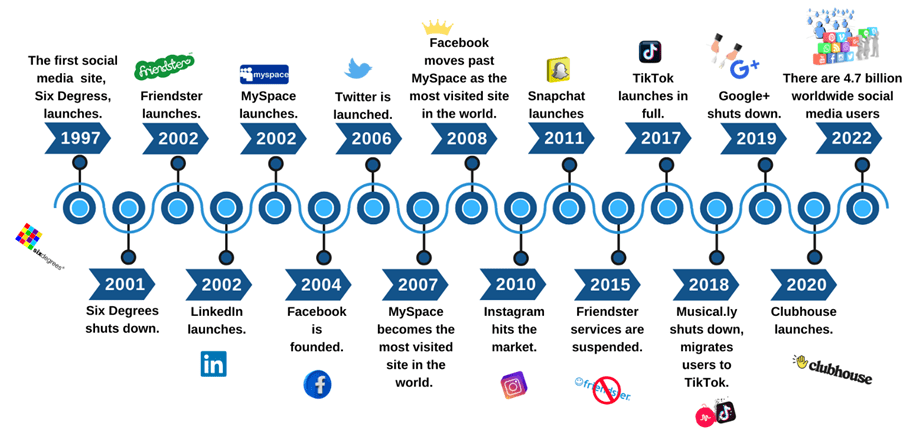
Broadband search: History of social media (2023) Available at: https://www.broadbandsearch.net/blog/complete-history-social-media
Nevertheless, it is important to acknowledge the positive side of the digital revolution for sports media. It has made the role of sports journalists more varied, challenging and more exciting, the need to be multiskilled and to embrace new technologies became vital. In addition, sports editors now have advanced tools like google analytics at their disposal, they can track which content is popular among their audience (Bradshaw & Minogue., 2019).
 Passion Universe